Cross-Validation Strategies: Stratified, Group & Time-Series CV
Cross-validation is one of the most important techniques for evaluating machine learning models. It helps determine whether a model can generalize to unseen data rather than simply memorizing patterns from its training dataset.
However, not every dataset should be evaluated using the same cross-validation strategy.
For example:
- In an imbalanced classification dataset, ordinary K-Fold may create folds with very different class distributions.
- In medical datasets, multiple records belonging to the same patient should not be split across training and validation sets.
- In stock market prediction, randomly mixing past and future observations can introduce data leakage.
These problems require specialized cross-validation strategies.
In this article, we will explore three important techniques:
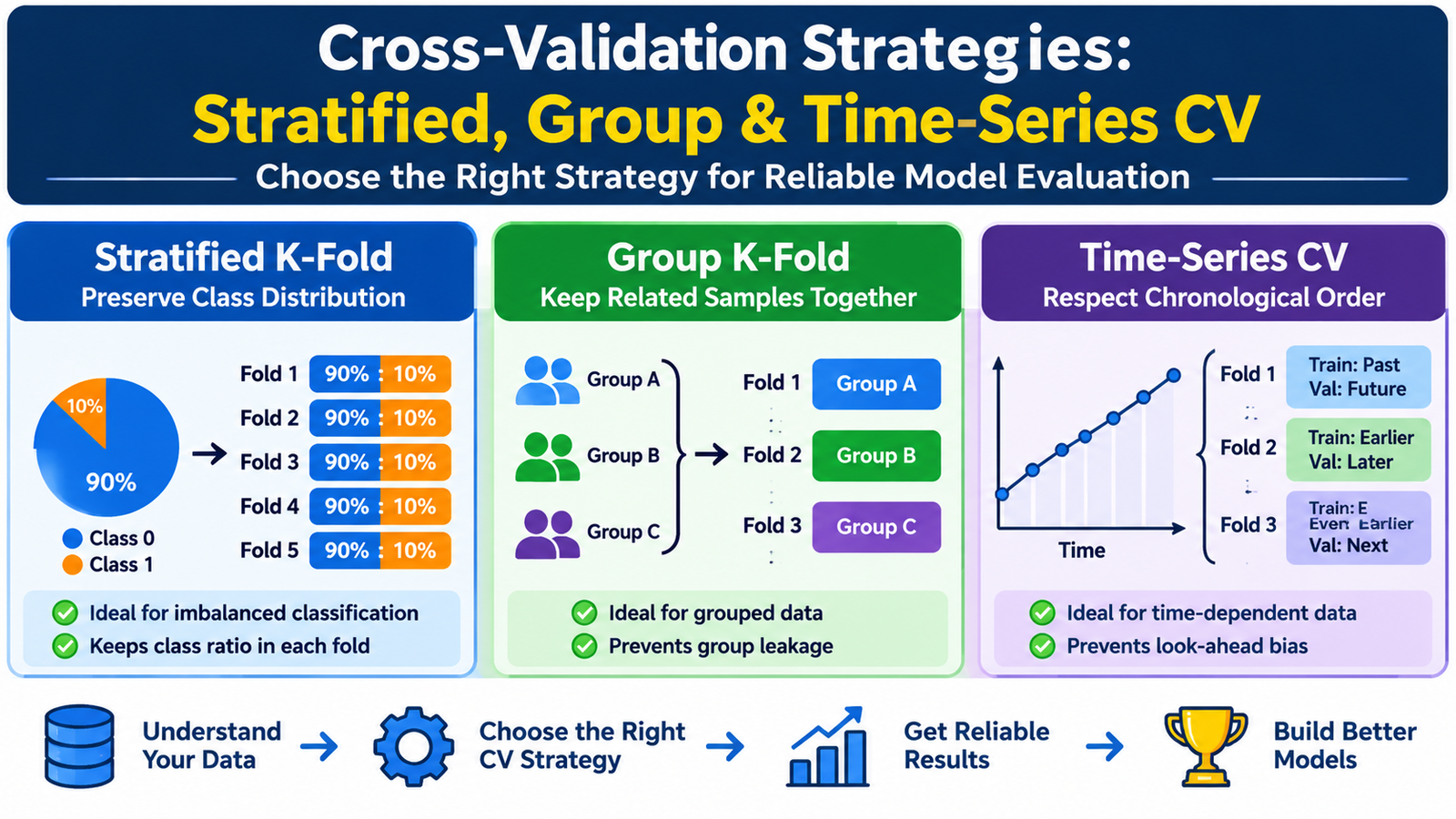
- Stratified Cross-Validation: Preserves class proportions across folds.
- Group Cross-Validation: Keeps related observations together.
- Time-Series Cross-Validation: Respects chronological order when evaluating time-dependent data.
We will also implement each strategy using Python and Scikit-learn.
1. What Is Cross-Validation in Machine Learning?
Cross-validation is a model evaluation technique that divides a dataset into multiple subsets, called folds.
The model is trained and evaluated multiple times using different combinations of training and validation subsets.
The main objective is to estimate how well a machine learning model performs on unseen data.
Why Do We Need Cross-Validation?
Suppose you have a dataset containing 1,000 records.
You divide it into:
- 800 records for training.
- 200 records for testing.
Your model achieves 95% accuracy on the test dataset.
But what if those 200 records happen to be unusually easy to predict?
A different train-test split might produce only 88% accuracy.
This means that a single split may not provide a sufficiently reliable estimate of model performance.
Cross-validation addresses this problem by evaluating the model across multiple data partitions.
Understanding K-Fold Cross-Validation
K-Fold Cross-Validation divides the dataset into K approximately equal-sized folds.
For example, with five-fold cross-validation:
- The dataset is divided into five folds.
- Four folds are used for training.
- One fold is used for validation.
- The process is repeated five times, changing the validation fold each time.
Each observation is used for validation once and for training in the other iterations.
K-Fold Cross-Validation Workflow
                 Complete Dataset
                        |
                        v
              Divide into 5 Folds
                        |
       +--------+--------+--------+--------+--------+
       | Fold 1 | Fold 2 | Fold 3 | Fold 4 | Fold 5 |
       +--------+--------+--------+--------+--------+
          |        |        |        |        |
       Run 1    Run 2    Run 3    Run 4    Run 5

       Validation Fold:
       1          2        3        4        5

       Remaining folds are used for training.

                        |
                        v
             Calculate Average Score
                        |
                        v
               Evaluate Model
The average cross-validation score is calculated as:
\[ CV_{\text{score}} = \frac{1}{K}\sum_{i=1}^{K}S_i \]
Where:
- \(K\) = Number of folds.
- \(S_i\) = Validation score from the \(i\)-th fold.
For example:
| Fold | Accuracy |
|---|---|
| Fold 1 | 91% |
| Fold 2 | 93% |
| Fold 3 | 92% |
| Fold 4 | 94% |
| Fold 5 | 90% |
\[ CV_{\text{score}} = \frac{91+93+92+94+90}{5} \]
\[ CV_{\text{score}} = 92\% \]
The average provides an estimate of model performance across multiple validation partitions.
However, ordinary K-Fold is not suitable for every dataset. That is why specialized cross-validation strategies are important.
2. Stratified Cross-Validation: Preserving Class Distribution
Stratified Cross-Validation is commonly used for classification problems, especially when the target classes are imbalanced.
It ensures that each fold approximately preserves the same class distribution as the complete dataset.
Why Is Stratification Important?
Imagine a classification dataset containing 1,000 customer records.
- 900 customers belong to Class 0.
- 100 customers belong to Class 1.
The class distribution is:
| Class | Records | Percentage |
|---|---|---|
| Class 0 | 900 | 90% |
| Class 1 | 100 | 10% |
| Total | 1,000 | 100% |
If you use ordinary K-Fold, the number of minority-class examples in each fold may vary.
For example:
| Fold | Class 0 | Class 1 |
|---|---|---|
| Fold 1 | 190 | 10 |
| Fold 2 | 185 | 15 |
| Fold 3 | 195 | 5 |
| Fold 4 | 180 | 20 |
| Fold 5 | 150 | 50 |
This uneven distribution can make performance comparisons less reliable.
Stratified K-Fold attempts to preserve the original 90:10 class ratio in every fold.
For five folds, the approximate distribution would be:
| Fold | Class 0 | Class 1 |
|---|---|---|
| Fold 1 | 180 | 20 |
| Fold 2 | 180 | 20 |
| Fold 3 | 180 | 20 |
| Fold 4 | 180 | 20 |
| Fold 5 | 180 | 20 |
Each fold now has approximately the same class distribution.
How Does Stratified K-Fold Work?
Complete Dataset
       |
       v
Separate Samples by Class
       |
       v
Distribute Each Class Across Folds
       |
       v
+---------+---------+---------+---------+---------+
| Fold 1  | Fold 2  | Fold 3  | Fold 4  | Fold 5  |
| 90:10   | 90:10   | 90:10   | 90:10   | 90:10   |
+---------+---------+---------+---------+---------+
       |
       v
Train and Validate Model
       |
       v
Calculate Average Score
Python Implementation: Stratified K-Fold
Scikit-learn provides StratifiedKFold for this purpose.
from sklearn.datasets import load_breast_cancer
from sklearn.ensemble import RandomForestClassifier
from sklearn.model_selection import StratifiedKFold
from sklearn.model_selection import cross_val_score

# Load dataset
data = load_breast_cancer()

X = data.data
y = data.target

# Create Stratified K-Fold
skf = StratifiedKFold(
    n_splits=5,
    shuffle=True,
    random_state=42
)

# Create model
model = RandomForestClassifier(
    n_estimators=100,
    random_state=42
)

# Perform cross-validation
scores = cross_val_score(
    model,
    X,
    y,
    cv=skf,
    scoring="accuracy"
)

# Display results
print("Fold Scores:", scores)

print("Average Accuracy:", scores.mean())

print("Standard Deviation:", scores.std())
Understanding the Code
StratifiedKFold: Creates folds that preserve class proportions.n_splits=5: Divides the dataset into five folds.shuffle=True: Shuffles observations before splitting.random_state=42: Makes the split reproducible.cross_val_score(): Trains and evaluates the model across all folds.scores.mean(): Calculates average validation performance.scores.std(): Measures variation in validation scores.
When Should You Use Stratified K-Fold?
Stratified K-Fold is especially useful for:
- Fraud detection.
- Medical diagnosis.
- Spam classification.
- Customer churn prediction.
- Sentiment classification.
- Any classification dataset with unequal class proportions.
Important: Stratified K-Fold is designed for classification targets. It does not solve problems involving repeated observations from the same entity or chronological dependencies.
3. Group Cross-Validation: Keeping Related Samples Together
Group Cross-Validation is used when multiple observations belong to the same individual, organization, device, or other entity.
The main objective is to ensure that observations belonging to the same group are never divided between training and validation datasets.
Why Is Group Cross-Validation Important?
Consider a medical dataset containing records from 100 patients.
Each patient has 10 medical measurements.
Therefore:
\[ 100 \times 10 = 1000 \text{ records} \]
Suppose the same patient's records appear in both training and validation datasets.
The model may learn patient-specific patterns from the training data and then perform well on that patient's validation records.
This can produce overly optimistic performance estimates.
However, the model may perform poorly when it encounters a completely new patient.
Group Cross-Validation prevents this type of leakage by keeping all records belonging to the same patient in a single fold.
Example: Medical Dataset
| Patient ID | Record | Dataset Assignment |
|---|---|---|
| P001 | Measurement 1 | Training |
| P001 | Measurement 2 | Training |
| P001 | Measurement 3 | Training |
| P002 | Measurement 1 | Validation |
| P002 | Measurement 2 | Validation |
| P003 | Measurement 1 | Training |
| P003 | Measurement 2 | Training |
Notice that all records belonging to one patient stay together.
Group Cross-Validation Workflow
             Complete Dataset
                    |
                    v
             Identify Groups
                    |
                    v
       +------------+------------+
       |            |            |
     Group A      Group B      Group C
       |            |            |
       v            v            v
   Assign Groups to Different Folds
                    |
                    v
       Train and Validate Without
        Splitting Individual Groups
                    |
                    v
           Calculate Model Score
Python Implementation: Group K-Fold
Scikit-learn provides GroupKFold for group-based validation.
import numpy as np

from sklearn.model_selection import GroupKFold
from sklearn.ensemble import RandomForestClassifier
from sklearn.model_selection import cross_val_score

# Create sample dataset
X = np.random.rand(100, 5)

y = np.random.randint(0, 2, 100)

# Create 20 groups, each containing 5 records
groups = np.repeat(np.arange(20), 5)

# Create Group K-Fold
gkf = GroupKFold(n_splits=5)

# Create model
model = RandomForestClassifier(
    n_estimators=100,
    random_state=42
)

# Perform group cross-validation
scores = cross_val_score(
    model,
    X,
    y,
    groups=groups,
    cv=gkf,
    scoring="accuracy"
)

print("Fold Scores:", scores)

print("Average Accuracy:", scores.mean())
Understanding the Code
GroupKFold: Creates folds while keeping each group intact.groups: Identifies which observations belong to the same entity.np.repeat(np.arange(20), 5): Creates 20 groups containing five observations each.n_splits=5: Creates five validation folds.cross_val_score(): Evaluates the model using group-aware splitting.
Note: The generated dataset above is only for demonstrating the splitting strategy. Its random features and labels do not represent a meaningful prediction problem.
Another Useful Strategy: Stratified Group K-Fold
Sometimes, a dataset requires both:
- Preserving class distribution.
- Keeping related observations together.
For example, a medical image dataset may contain multiple images per patient, and the target classes may be imbalanced.
In this situation, StratifiedGroupKFold is useful.
from sklearn.model_selection import StratifiedGroupKFold
from sklearn.model_selection import cross_val_score
from sklearn.ensemble import RandomForestClassifier

sgkf = StratifiedGroupKFold(
    n_splits=5,
    shuffle=True,
    random_state=42
)

model = RandomForestClassifier(
    n_estimators=100,
    random_state=42
)

scores = cross_val_score(
    model,
    X,
    y,
    groups=groups,
    cv=sgkf,
    scoring="accuracy"
)

print("Fold Scores:", scores)

print("Average Accuracy:", scores.mean())
Stratification is approximate, and exact class proportions may not be achievable when groups are large or unevenly distributed.
When Should You Use Group Cross-Validation?
Group Cross-Validation is particularly useful for:
- Medical records containing multiple observations per patient.
- Customer datasets containing repeated transactions.
- Image datasets containing multiple images per person.
- Sensor data containing measurements from different devices.
- Research datasets containing multiple observations per subject.
- User activity prediction with repeated records per user.
Best Practice: If your goal is to predict outcomes for entirely new users, patients, or devices, use a group-aware validation strategy.
4. Time-Series Cross-Validation: Respecting Chronological Order
Time-Series Cross-Validation is designed for datasets where observations are ordered by time.
Examples include:
- Stock market prices.
- Weather forecasting.
- Sales prediction.
- Electricity demand forecasting.
- Website traffic forecasting.
- Inventory demand prediction.
Unlike ordinary K-Fold, time-series validation must preserve chronological order.
Why Is Random Shuffling Dangerous?
Imagine a dataset containing stock prices from January to December.
If you randomly shuffle observations, the model may train on December data and validate on January data.
This creates a situation where future information is used to predict the past.
Such an evaluation does not represent how the model would actually operate in production.
This problem is called temporal data leakage.
Understanding Time-Series Cross-Validation
Time-Series Cross-Validation generally trains the model on past observations and evaluates it on later observations.
Scikit-learn provides TimeSeriesSplit to implement this approach.
Expanding Window Validation
In an expanding window strategy, the training dataset grows over time.
For example:
Fold 1:
Training: [Jan Feb Mar]
Validation: [Apr]

Fold 2:
Training: [Jan Feb Mar Apr]
Validation: [May]

Fold 3:
Training: [Jan Feb Mar Apr May]
Validation: [Jun]

Fold 4:
Training: [Jan Feb Mar Apr May Jun]
Validation: [Jul]
The model always learns from past data and predicts future observations.
Time-Series Cross-Validation Workflow
             Chronological Dataset
                       |
                       v
               Preserve Time Order
                       |
                       v
       +-----------------------------+
       | Fold 1: Train -> Validate   |
       +-----------------------------+
                       |
                       v
       +-----------------------------+
       | Fold 2: Larger Train -> Val |
       +-----------------------------+
                       |
                       v
       +-----------------------------+
       | Fold 3: Larger Train -> Val |
       +-----------------------------+
                       |
                       v
              Calculate Performance
                       |
                       v
               Evaluate Forecasting
Python Implementation: TimeSeriesSplit
import numpy as np

from sklearn.model_selection import TimeSeriesSplit

# Create sample time-series data
X = np.arange(20).reshape(-1, 1)

# Create TimeSeriesSplit
tscv = TimeSeriesSplit(n_splits=4)

# Display each fold
for fold, (train_index, test_index) in enumerate(
    tscv.split(X), start=1
):

    print(f"Fold {fold}")

    print("Training Index:", train_index)

    print("Validation Index:", test_index)

    print()
Example Output
Fold 1
Training Index: [0 1 2 3]
Validation Index: [4 5 6 7]

Fold 2
Training Index: [0 1 2 3 4 5 6 7]
Validation Index: [8 9 10 11]

Fold 3
Training Index: [0 1 2 3 4 5 6 7 8 9 10 11]
Validation Index: [12 13 14 15]

Fold 4
Training Index: [0 1 2 3 4 5 6 7 8 9 10 11 12 13 14 15]
Validation Index: [16 17 18 19]
Each subsequent fold uses a larger training window and evaluates on a later period.
Applying Time-Series Cross-Validation to a Forecasting Model
import numpy as np

from sklearn.model_selection import TimeSeriesSplit
from sklearn.ensemble import RandomForestRegressor
from sklearn.metrics import mean_absolute_error

# Generate sample chronological data
X = np.arange(100).reshape(-1, 1)

y = 2 * X.ravel() + np.random.normal(
    0, 5, 100
)

# Create time-series split
tscv = TimeSeriesSplit(n_splits=5)

# Create model
model = RandomForestRegressor(
    n_estimators=100,
    random_state=42
)

scores = []

for train_index, test_index in tscv.split(X):

    X_train, X_test = X[train_index], X[test_index]

    y_train, y_test = y[train_index], y[test_index]

    model.fit(X_train, y_train)

    predictions = model.predict(X_test)

    mae = mean_absolute_error(
        y_test,
        predictions
    )

    scores.append(mae)

print("MAE for each fold:", scores)

print("Average MAE:", np.mean(scores))
This example demonstrates the validation procedure. In a real forecasting project, the features should be constructed using only information available at the prediction time.
Important Time-Series Parameters
TimeSeriesSplit supports several useful parameters:
| Parameter | Description |
|---|---|
| n_splits | Number of validation splits |
| test_size | Number of observations in each validation set |
| max_train_size | Maximum training window size |
| gap | Number of observations excluded between training and validation |
For example:
tscv = TimeSeriesSplit(
    n_splits=5,
    test_size=10,
    gap=2,
    max_train_size=50
)
Here:
- Each validation fold contains 10 observations.
- Two observations are excluded between training and validation.
- The training window is limited to 50 observations.
The gap parameter can help reduce leakage when nearby observations share information, although the appropriate gap depends on the forecasting setup.
Expanding Window vs. Sliding Window
There are two common time-series training strategies.
1. Expanding Window
The training window grows as new observations become available.
Fold 1: [Jan Feb Mar] -> [Apr]

Fold 2: [Jan Feb Mar Apr] -> [May]

Fold 3: [Jan Feb Mar Apr May] -> [Jun]
Useful when older historical observations remain relevant.
2. Sliding Window
The training window remains approximately the same size while moving forward.
Fold 1: [Jan Feb Mar] -> [Apr]

Fold 2: [Feb Mar Apr] -> [May]

Fold 3: [Mar Apr May] -> [Jun]
Useful when older data becomes less relevant because of changing patterns.
Standard TimeSeriesSplit uses expanding training sets by default. A fixed-size sliding window can be implemented using its max_train_size parameter.
When Should You Use Time-Series Cross-Validation?
- Stock price forecasting.
- Weather prediction.
- Sales forecasting.
- Electricity consumption prediction.
- Demand forecasting.
- Predicting website traffic.
- Industrial sensor forecasting.
Important: Time-series cross-validation should never allow future information to leak into the training process. This includes preprocessing, feature engineering, and target construction.
5. K-Fold vs. Stratified K-Fold vs. Group K-Fold vs. Time-Series CV
Each cross-validation technique solves a different evaluation problem.
| Feature | K-Fold | Stratified K-Fold | Group K-Fold | Time-Series CV |
|---|---|---|---|---|
| Main purpose | General evaluation | Preserve class proportions | Keep groups together | Preserve chronological order |
| Classification | Yes | Yes | Yes | Possible, depending on task |
| Regression | Yes | Not directly | Yes | Yes |
| Handles imbalanced classes | Not guaranteed | Yes, approximately | Not guaranteed | Not guaranteed |
| Prevents group overlap | No | No | Yes | No, not by itself |
| Preserves time order | No | No | No | Yes |
| Typical application | General ML | Fraud detection | Patient prediction | Sales forecasting |
Which Strategy Should You Choose?
| Dataset Situation | Recommended Strategy |
|---|---|
| Balanced classification dataset | K-Fold |
| Imbalanced classification dataset | Stratified K-Fold |
| Multiple records per customer | Group K-Fold |
| Multiple images per patient | Group K-Fold or Stratified Group K-Fold |
| Stock market forecasting | TimeSeriesSplit |
| Historical sales prediction | TimeSeriesSplit |
| Imbalanced classification with repeated users | StratifiedGroupKFold |
The most important principle is to select a validation strategy that reflects how the model will encounter new data in the real world.
6. Cross-Validation and Hyperparameter Tuning
Cross-validation is frequently combined with hyperparameter tuning to identify better model configurations.
For example, GridSearchCV and RandomizedSearchCV can accept different cross-validation strategies.
Example: Hyperparameter Tuning with Stratified K-Fold
from sklearn.datasets import load_breast_cancer
from sklearn.ensemble import RandomForestClassifier

from sklearn.model_selection import (
    StratifiedKFold,
    GridSearchCV
)

# Load dataset
data = load_breast_cancer()

X = data.data
y = data.target

# Define cross-validation
cv = StratifiedKFold(
    n_splits=5,
    shuffle=True,
    random_state=42
)

# Create model
model = RandomForestClassifier(
    random_state=42
)

# Define search space
param_grid = {
    "n_estimators": [50, 100, 200],
    "max_depth": [5, 10, 20]
}

# Create Grid Search
grid = GridSearchCV(
    estimator=model,
    param_grid=param_grid,
    cv=cv,
    scoring="accuracy",
    n_jobs=-1
)

# Train and tune
grid.fit(X, y)

print("Best Parameters:", grid.best_params_)

print("Best CV Score:", grid.best_score_)
This example uses Stratified K-Fold inside Grid Search.
For time-series datasets, the same idea can be applied with TimeSeriesSplit and an appropriate forecasting model.
For grouped data, pass a group-aware splitter and provide the group labels to the search object's fit() method.
7. Common Cross-Validation Mistakes to Avoid
Even when the correct cross-validation strategy is selected, mistakes in implementation can produce misleading evaluation results.
1. Using Random K-Fold for Time-Series Data
Randomly mixing past and future observations can cause temporal leakage.
Solution: Use chronological splitting such as TimeSeriesSplit.
2. Splitting Records from the Same Group
If records from the same patient or customer appear in both training and validation datasets, the model may learn group-specific patterns.
Solution: Use GroupKFold or StratifiedGroupKFold, depending on the problem.
3. Ignoring Class Imbalance
Some folds may contain very few minority-class observations.
Solution: Use StratifiedKFold for appropriate classification problems.
4. Preprocessing Before Cross-Validation
Consider scaling the complete dataset before splitting it into folds.
The scaler learns information from validation observations, creating leakage.
Solution: Use Scikit-learn Pipelines so preprocessing is fitted independently inside each training fold.
from sklearn.pipeline import Pipeline
from sklearn.preprocessing import StandardScaler
from sklearn.linear_model import LogisticRegression

from sklearn.model_selection import (
    StratifiedKFold,
    cross_val_score
)

pipeline = Pipeline([
    ("scaler", StandardScaler()),
    ("model", LogisticRegression(max_iter=1000))
])

cv = StratifiedKFold(
    n_splits=5,
    shuffle=True,
    random_state=42
)

scores = cross_val_score(
    pipeline,
    X,
    y,
    cv=cv,
    scoring="accuracy"
)

print("Average Accuracy:", scores.mean())
5. Choosing Too Many or Too Few Folds
More folds increase the number of model training runs and computational cost.
Fewer folds reduce computation but may produce less stable estimates.
Choose the number of folds based on dataset size, available resources, and the evaluation requirements.
6. Using the Test Dataset During Model Selection
Repeatedly checking test performance while adjusting model configurations turns the test dataset into part of the model selection process.
Solution: Keep a separate test dataset untouched until the final evaluation.
8. Best Practices for Reliable Cross-Validation
Follow these recommendations when evaluating machine learning models:
- Understand the structure of your dataset before selecting a validation strategy.
- Use Stratified K-Fold for classification problems where class proportions matter.
- Use Group K-Fold when observations belong to repeated entities.
- Use TimeSeriesSplit for chronological prediction tasks.
- Use StratifiedGroupKFold when both group separation and approximate class balance are required.
- Apply preprocessing through Scikit-learn Pipelines.
- Select evaluation metrics that match the business problem.
- Avoid using the test dataset during hyperparameter selection.
- Record fold-level scores, average scores, and score variation.
- Ensure that feature engineering uses only information available at prediction time.
A reliable evaluation strategy should reproduce the conditions under which the model will actually make predictions.
9. Real-World Applications of Different Cross-Validation Strategies
| Industry | Problem | Recommended Strategy |
|---|---|---|
| Healthcare | Predicting disease for new patients | Group K-Fold |
| Banking | Credit card fraud classification | Stratified K-Fold |
| E-commerce | Customer purchase prediction | Group K-Fold when users repeat |
| Finance | Stock price forecasting | TimeSeriesSplit |
| Retail | Future sales forecasting | TimeSeriesSplit |
| Computer Vision | Classifying images from unseen people | Group K-Fold |
| Manufacturing | Predicting equipment failure | Group or Time-Series CV, depending on deployment |
| Social Media | Sentiment classification | Stratified K-Fold, if observations are independent |
The correct choice depends on what counts as genuinely unseen data in the intended application.
10. Frequently Asked Questions (FAQs)
Q1. What is cross-validation in machine learning?
Cross-validation is a model evaluation technique that repeatedly divides data into training and validation subsets to estimate how well a model generalizes to unseen observations.
Q2. What is the difference between K-Fold and Stratified K-Fold?
K-Fold divides observations into approximately equal-sized folds without explicitly preserving class proportions. Stratified K-Fold attempts to maintain the original class distribution in every fold.
Q3. Why is Group K-Fold important?
Group K-Fold ensures that observations belonging to the same group do not appear in both training and validation sets. This helps prevent overly optimistic evaluation caused by group overlap.
Q4. What is Time-Series Cross-Validation?
Time-Series Cross-Validation evaluates models using chronological splits. The model trains on historical observations and validates on later observations.
Q5. Can we use Stratified K-Fold for regression?
Standard StratifiedKFold is designed for classification targets. Regression problems generally use K-Fold or another suitable splitter. If stratification is needed, target values can sometimes be grouped into bins, but this requires careful justification.
Q6. What is StratifiedGroupKFold?
StratifiedGroupKFold attempts to preserve class proportions while ensuring that observations from the same group remain in the same fold.
Q7. What is the difference between expanding and sliding window validation?
Expanding window validation gradually increases the training dataset. Sliding window validation maintains a fixed-size training window that moves forward over time.
Q8. Does cross-validation prevent overfitting?
Cross-validation helps detect overfitting and estimate generalization performance, but it does not automatically prevent a model from overfitting. Model regularization, suitable feature selection, and appropriate validation are also important.
Q9. How many folds should we use?
Five-fold and ten-fold cross-validation are common choices. The best number depends on dataset size, computational resources, and the problem structure.
Q10. Which cross-validation technique is best?
There is no universally best technique. Use Stratified K-Fold for class distribution preservation, Group K-Fold for related observations, and Time-Series CV for chronological data.
Conclusion
Cross-validation is essential for evaluating machine learning models reliably, but choosing the correct strategy is just as important as choosing the model itself.
The three specialized strategies covered in this guide solve different challenges:
- Stratified K-Fold preserves approximate class proportions across folds.
- Group K-Fold keeps related observations together to reduce group leakage.
- Time-Series Cross-Validation respects chronological order and evaluates predictions on future observations.
A model that achieves excellent validation accuracy using an inappropriate splitting strategy may fail when deployed in the real world.
Therefore, always consider the structure of your data, the relationships between observations, and the way predictions will be made in production.
Remember: Good model evaluation starts with the right data-splitting strategy. A reliable validation process is the foundation of a reliable machine learning model.
Author: Kulbhushan Pukale
Category: AI & Machine Learning