LightGBM vs. CatBoost vs. XGBoost: Complete Comparison
Gradient Boosting is one of the most powerful techniques in machine learning, particularly when working with structured and tabular datasets.
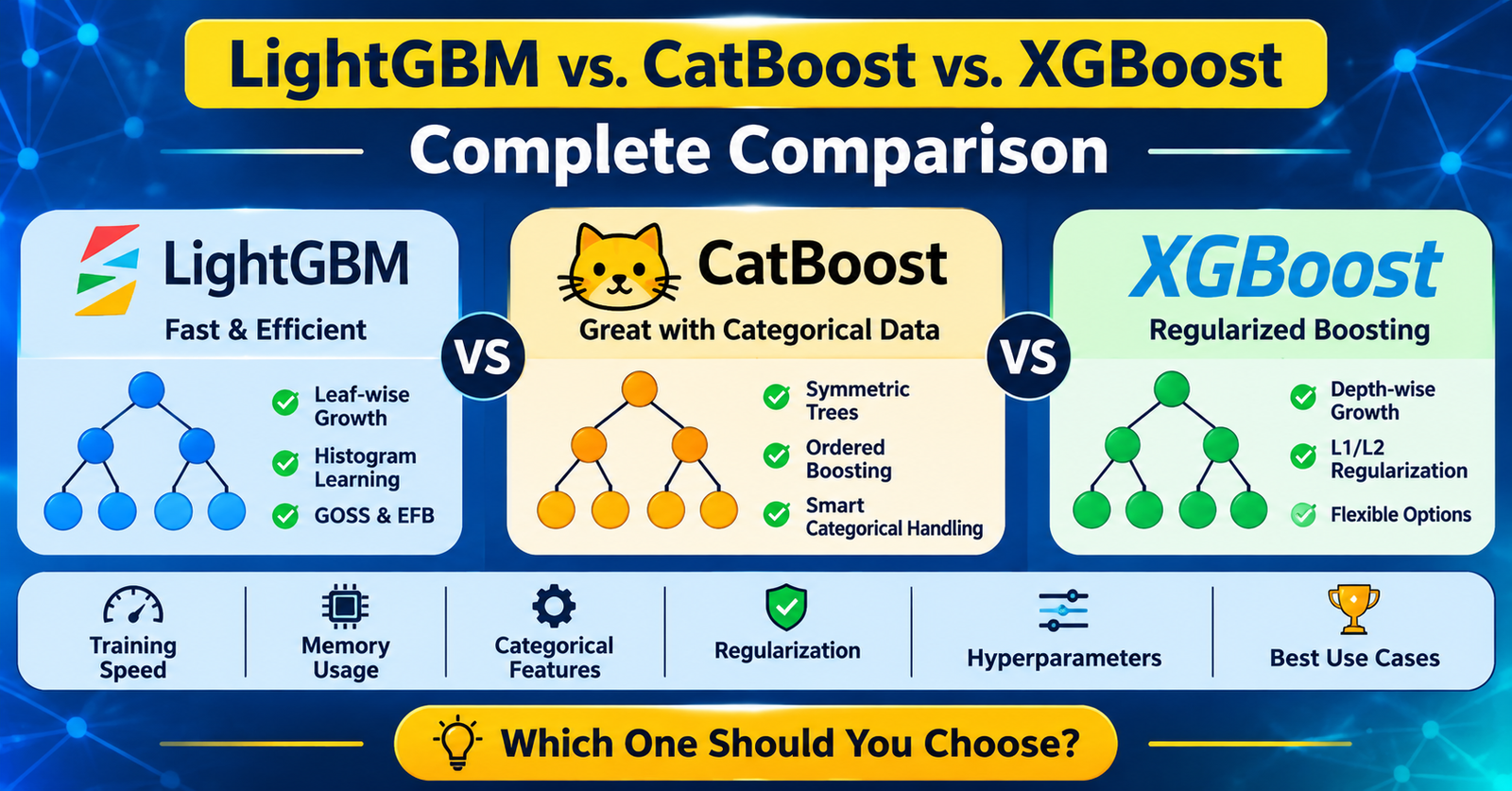
Among the most popular gradient-boosting frameworks are XGBoost, LightGBM, and CatBoost. All three build ensembles of decision trees sequentially, learning from previous prediction errors. However, they differ significantly in their tree-building strategies, categorical feature handling, training optimizations, regularization techniques, and hyperparameter configurations.
For example:
- XGBoost is known for its regularized learning objective and flexible training options.
- LightGBM focuses on efficient histogram-based learning and leaf-wise tree growth.
- CatBoost is designed to handle categorical features effectively using ordered statistics and specialized boosting techniques.
But which one should you choose?
Is LightGBM always faster than XGBoost? Is CatBoost better when your dataset contains categorical variables? Does XGBoost still have an advantage in terms of flexibility?
In this guide, we will compare all three algorithms from their internal working mechanisms to practical Python implementations, performance considerations, hyperparameter tuning, and real-world applications.
1. What Are XGBoost, LightGBM, and CatBoost?
All three frameworks implement Gradient Boosted Decision Trees (GBDT).
Gradient boosting is an ensemble learning technique that combines multiple decision trees to create a stronger predictive model.
Instead of training every tree independently, boosting builds trees sequentially. Each new tree attempts to improve the predictions made by the existing ensemble.
The general prediction formula is:
\[ \hat{y}i = \sum{k=1}^{K} f_k(x_i) \]
Where:
- \(\hat{y}_i\) = final prediction.
- \(K\) = number of trees.
- \(f_k\) = prediction produced by tree \(k\).
- \(x_i\) = input features.
Each framework follows this fundamental boosting principle but uses different engineering and algorithmic techniques.
XGBoost
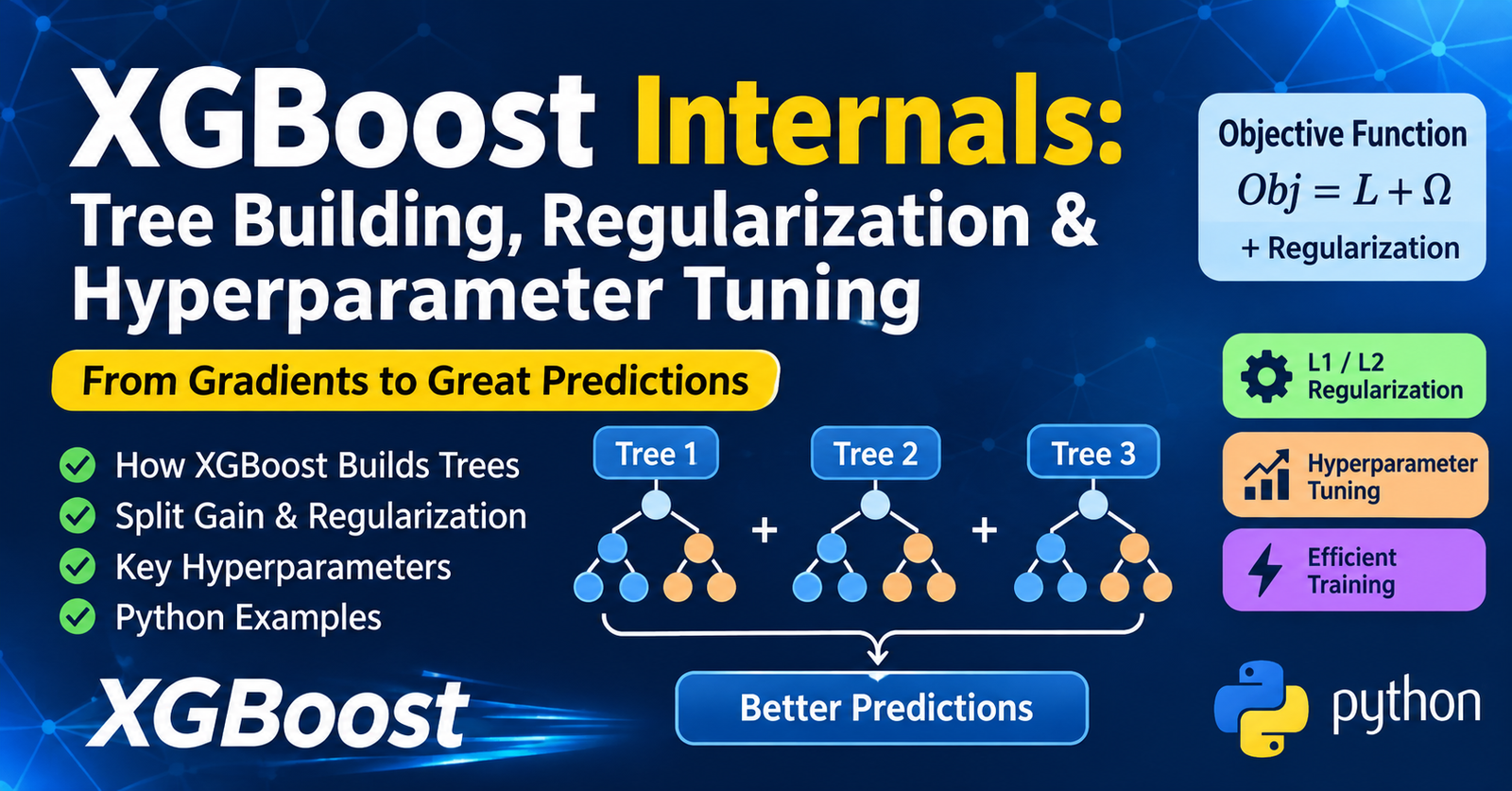
XGBoost (Extreme Gradient Boosting) is an optimized gradient-boosting framework known for regularization, second-order optimization, missing-value handling, and efficient tree construction.
Important characteristics:
- Uses gradients and Hessians to optimize the objective.
- Supports L1 and L2 regularization.
- Supports depth-wise and loss-guided tree growth.
- Provides histogram-based tree construction.
- Supports native categorical features in supported configurations.
- Offers CPU and GPU training options.
LightGBM
LightGBM (Light Gradient Boosting Machine) is a gradient-boosting framework designed to improve training efficiency and memory usage, especially on large datasets.
Important characteristics:
- Uses histogram-based split finding.
- Grows trees leaf-wise using best-first expansion.
- Supports categorical feature handling.
- Uses techniques such as Gradient-based One-Side Sampling (GOSS) and Exclusive Feature Bundling (EFB).
- Supports parallel and distributed training configurations.
CatBoost
CatBoost (Categorical Boosting) is a gradient-boosting framework developed with particular attention to categorical features and prediction quality.
Important characteristics:
- Handles categorical features without requiring conventional one-hot encoding for every category.
- Uses ordered target statistics to reduce target leakage.
- Introduces ordered boosting to address prediction shift.
- Uses symmetric (oblivious) trees by default.
- Provides CPU and GPU training options.
2. How Do These Algorithms Build Decision Trees?
The most important difference between the three frameworks is how they construct and grow decision trees.
XGBoost: Depth-Wise Tree Growth by Default
XGBoost uses depth-wise tree growth by default.
In this strategy, the algorithm expands nodes level by level, subject to its tree constraints and split-gain requirements.
Conceptually:
             Root
            /    \
          Node   Node
          / \     / \
         L   L   L   L
At each level, eligible nodes are evaluated for possible splits.
XGBoost also supports a loss-guided growth policy, which expands leaves according to their potential loss reduction.
Its major strength is the combination of flexible tree construction and explicit regularization.
LightGBM: Leaf-Wise Tree Growth
LightGBM uses leaf-wise, or best-first, tree growth.
Instead of expanding every eligible node at the same depth, it selects the leaf that offers the greatest estimated improvement in the objective function.
Conceptually:
             Root
            /    \
          Node   Leaf
          /  \
        Node Leaf
        /  \
      Leaf Leaf
The algorithm focuses its next split on the leaf with the highest potential gain.
This can achieve a lower training loss with a limited number of leaves, but it can also create deep, asymmetric trees.
Therefore, important parameters include:
num_leavesmax_depthmin_child_samplesmin_child_weight
CatBoost: Symmetric (Oblivious) Trees by Default
CatBoost generally uses symmetric or oblivious trees by default.
In a symmetric tree, the same splitting condition is applied across all nodes at a particular depth.
For example:
                Age < 30?
                /      \
          Yes /          \ No
             /            \
       Income < 50K?   Income < 50K?
          /    \          /    \
         L      L        L      L
This creates a balanced tree structure.
Advantages include:
- Predictable tree structure.
- Efficient prediction.
- Controlled model complexity.
- Convenient vectorized computations.
CatBoost also provides other tree-growing policies, but symmetric trees are its characteristic default.
Tree Growth Comparison
| Feature | XGBoost | LightGBM | CatBoost |
|---|---|---|---|
| Default growth strategy | Depth-wise | Leaf-wise | Symmetric |
| Tree structure | Generally balanced | Often asymmetric | Balanced and symmetric |
| Main control | max_depth | num_leaves | depth |
| Main advantage | Flexible tree construction | Focused loss reduction | Structured tree evaluation |
| Main concern | Requires appropriate complexity tuning | Can overfit with aggressive growth | Symmetric structure can be restrictive |
The tree-growth strategy influences model complexity, training behavior, and prediction performance. It does not guarantee that one framework will always achieve better results.
3. How Do They Handle Categorical Features?
Categorical features represent values that belong to distinct groups rather than continuous numerical measurements.
Examples:
City:       Delhi, Mumbai, Bangalore
Gender:     Male, Female, Other
Department: Sales, Marketing, Engineering
Product:    Laptop, Mobile, Tablet
Traditional machine learning workflows often convert categorical values into numerical representations before training.
However, XGBoost, LightGBM, and CatBoost provide different approaches to categorical data.
XGBoost: Native Categorical Support
XGBoost supports native categorical feature handling in supported versions and configurations.
You can use pandas categorical columns with:
X["City"] = X["City"].astype("category")

model = XGBClassifier(
    enable_categorical=True,
    tree_method="hist"
)
It supports categorical split strategies, including optimal partitioning for suitable categorical features.
If native categorical support is not being used, you can also apply preprocessing such as one-hot encoding.
LightGBM: Native Categorical Handling
LightGBM can recognize categorical features through pandas categorical columns or explicit categorical feature specifications.
Example:
X["City"] = X["City"].astype("category")

model = LGBMClassifier(
    categorical_feature="auto"
)
Instead of treating every category as an unrelated numerical value, LightGBM can evaluate category groupings during split finding.
This can be useful when categorical features have many distinct values.
CatBoost: Ordered Target Statistics
CatBoost is particularly well known for its categorical-feature processing.
One of its techniques is ordered target statistics.
Consider a dataset:
| City | Purchased |
|---|---|
| Delhi | 1 |
| Mumbai | 0 |
| Delhi | 1 |
| Bangalore | 0 |
| Mumbai | 1 |
A naive target-encoding approach calculates category statistics using all training labels.
However, using the same observation's target to encode its own feature can introduce target leakage.
CatBoost addresses this problem through ordered statistics, using permutations and prior observations to calculate category-related statistics without directly using the current observation's target.
CatBoost also processes combinations of categorical features.
Example:
from catboost import CatBoostClassifier

model = CatBoostClassifier(
    iterations=500,
    depth=6,
    learning_rate=0.05,
    verbose=False
)

model.fit(
    X_train,
    y_train,
    cat_features=["City", "Department"]
)
The categorical columns can be supplied directly in the supported input formats.
Categorical Feature Comparison
| Feature | XGBoost | LightGBM | CatBoost |
|---|---|---|---|
| Native categorical support | Yes, supported configurations | Yes | Yes |
| Categorical processing | Category partitioning and one-hot options | Category grouping | Ordered target statistics |
| Manual encoding | Optional, depending on setup | Optional, depending on setup | Usually less necessary |
| High-cardinality features | Supported with suitable configuration | Supported with suitable configuration | Particularly useful |
| Special technique | Optimal partitioning | Histogram-based category splitting | Ordered statistics |
Practical takeaway: CatBoost is an excellent candidate when categorical features are central to the problem. However, native categorical support is not exclusive to CatBoost.
4. Internal Optimization Techniques
Each framework uses different techniques to improve training efficiency and prediction quality.
XGBoost: Regularized Second-Order Optimization
XGBoost uses both gradients and Hessians to optimize its objective function.
Its general objective is:
\[ Obj = L + \Omega \]
Where:
- \(L\) = training loss.
- \(\Omega\) = tree complexity penalty.
A commonly used tree regularization expression is:
\[ \Omega(f)=\gamma T+ \frac{1}{2}\lambda\sum_{j=1}^{T}w_j^2 \]
This penalizes unnecessary leaves and large leaf weights.
XGBoost also supports:
- Sparse-aware split finding.
- Histogram-based training.
- Column sampling.
- Row subsampling.
- Distributed training.
LightGBM: Histogram-Based Learning
LightGBM converts continuous feature values into discrete bins.
For example:
Original values:

12, 18, 23, 29, 34, 41, 48, 55

Binned values:

 1,  1,  2,  2,  3,  3,  4,  4
Instead of evaluating every unique feature value, the algorithm evaluates candidate splits using these bins.
Benefits include:
- Faster split evaluation in many workloads.
- Reduced memory requirements.
- Efficient histogram calculations.
- Histogram subtraction to reduce repeated computation.
LightGBM also uses two important techniques.
GOSS (Gradient-based One-Side Sampling)
GOSS retains observations with large gradient magnitudes and samples a portion of observations with smaller gradients.
The objective is to reduce computation while preserving important gradient information through appropriate weighting.
EFB (Exclusive Feature Bundling)
EFB combines mutually exclusive sparse features into fewer bundled features.
For example, if two features are rarely non-zero in the same observation, they may be bundled to reduce the effective feature count.
CatBoost: Ordered Boosting
A major challenge in boosting with categorical target statistics is prediction shift caused by target leakage.
CatBoost introduces ordered boosting to reduce this problem.
Conceptually, it uses permutations of training examples and computes learning information using observations that precede the current observation in the relevant ordering.
This helps prevent a model from using information from an observation's own target in an inappropriate way during training.
CatBoost also uses symmetric trees by default, which gives its model a structured and predictable architecture.
Optimization Comparison
| Technique | XGBoost | LightGBM | CatBoost |
|---|---|---|---|
| Second-order optimization | Yes | Yes | Yes |
| Histogram learning | Supported | Core technique | Supported |
| Ordered boosting | No equivalent default method | No equivalent default method | Yes |
| GOSS | No | Yes | No |
| EFB | No equivalent core technique | Yes | No |
| Symmetric trees by default | No | No | Yes |
5. XGBoost vs. LightGBM vs. CatBoost: Complete Comparison
Let's compare the three frameworks across important machine learning and engineering dimensions.
| Comparison | XGBoost | LightGBM | CatBoost |
|---|---|---|---|
| Full name | Extreme Gradient Boosting | Light Gradient Boosting Machine | Categorical Boosting |
| Main focus | Regularized boosting | Efficient histogram-based boosting | Categorical data and ordered boosting |
| Tree growth | Depth-wise by default | Leaf-wise | Symmetric by default |
| Categorical support | Native | Native | Native |
| Missing-value handling | Built-in | Built-in | Built-in |
| Regularization | L1, L2 and tree constraints | L1, L2 and tree constraints | Multiple regularization controls |
| Histogram learning | Supported | Core technique | Supported |
| GPU training | Supported | Supported | Supported |
| CPU training | Supported | Supported | Supported |
| Distributed training | Supported | Supported | Supported |
| Python API | Yes | Yes | Yes |
| Classification | Yes | Yes | Yes |
| Regression | Yes | Yes | Yes |
| Ranking | Yes | Yes | Yes |
All three are powerful frameworks. Their differences are primarily in implementation strategies, defaults, categorical processing, and available optimization features.
6. Training Speed and Memory Usage
Training speed is one of the most common reasons developers compare these libraries.
However, it is incorrect to assume that LightGBM is always faster or CatBoost is always slower.
Actual performance depends on:
- Number of rows.
- Number of features.
- Feature sparsity.
- Categorical feature cardinality.
- Data types.
- CPU and GPU hardware.
- Memory availability.
- Hyperparameter settings.
- Dataset preprocessing.
- Number of boosting rounds.
XGBoost
XGBoost provides optimized training algorithms, including histogram-based training.
It is a strong general-purpose choice for structured datasets and provides flexible CPU and GPU configurations.
LightGBM
LightGBM is often attractive for large tabular datasets because its histogram-based approach and leaf-wise growth can reduce training time in suitable workloads.
Its histogram construction, subtraction, and sparse optimization techniques help improve computational efficiency.
CatBoost
CatBoost can require additional computation for categorical statistics and its boosting process.
However, its categorical handling may reduce the amount of external preprocessing required.
On category-heavy datasets, this can make the complete workflow more convenient.
Important Benchmarking Rule
Never compare these frameworks using different datasets, different train-test splits, or different evaluation metrics.
A fair benchmark should use:
- The same dataset.
- The same training and validation splits.
- The same evaluation metric.
- Comparable parameter-search budgets.
- The same hardware environment.
- Consistent early-stopping rules.
Training speed alone should not determine the final model choice. Validation performance, inference latency, model size, and deployment requirements matter too.
7. Hyperparameter Comparison
Each framework has its own parameter names and controls.
Understanding their differences is essential when tuning models.
Important XGBoost Parameters
| Parameter | Purpose |
|---|---|
n_estimators | Number of boosting rounds |
learning_rate | Contribution of each tree |
max_depth | Maximum tree depth |
min_child_weight | Minimum child Hessian sum |
gamma | Minimum split loss reduction |
subsample | Fraction of training rows sampled |
colsample_bytree | Fraction of features sampled |
reg_alpha | L1 regularization |
reg_lambda | L2 regularization |
Important LightGBM Parameters
| Parameter | Purpose |
|---|---|
n_estimators | Number of boosting rounds |
learning_rate | Learning rate |
num_leaves | Maximum number of leaves |
max_depth | Maximum tree depth |
min_child_samples | Minimum observations in a leaf |
subsample | Row sampling |
colsample_bytree | Feature sampling |
reg_alpha | L1 regularization |
reg_lambda | L2 regularization |
The num_leaves parameter is especially important because LightGBM uses leaf-wise tree growth.
Important CatBoost Parameters
| Parameter | Purpose |
|---|---|
iterations | Number of boosting iterations |
learning_rate | Learning rate |
depth | Tree depth |
l2_leaf_reg | L2 regularization |
random_strength | Randomness used in split scoring |
bagging_temperature | Bayesian bootstrap sampling control |
border_count | Number of numerical feature borders |
loss_function | Training objective |
eval_metric | Evaluation metric |
CatBoost uses its own parameter names and defaults, so parameters should not be copied directly from XGBoost or LightGBM.
8. Practical Python Implementation
Now let's train all three algorithms on the same dataset and compare their classification performance.
We will use the Breast Cancer Wisconsin dataset from Scikit-learn.
Step 1: Install Libraries
pip install xgboost lightgbm catboost scikit-learn pandas numpyStep 2: Import Libraries
import time

import pandas as pd

from sklearn.datasets import load_breast_cancer
from sklearn.model_selection import train_test_split
from sklearn.metrics import (
    accuracy_score,
    precision_score,
    recall_score,
    f1_score,
    roc_auc_score
)

from xgboost import XGBClassifier
from lightgbm import LGBMClassifier
from catboost import CatBoostClassifier
Step 3: Load Dataset
data = load_breast_cancer()

X = pd.DataFrame(
    data.data,
    columns=data.feature_names
)

y = data.target

print(X.head())
print(y[:10])
Step 4: Split Dataset
X_train, X_test, y_train, y_test = train_test_split(
    X,
    y,
    test_size=0.2,
    random_state=42,
    stratify=y
)
All three models will use the same training and testing subsets.
Step 5: Initialize Models
models = {
    "XGBoost": XGBClassifier(
        n_estimators=200,
        learning_rate=0.05,
        max_depth=4,
        subsample=0.8,
        colsample_bytree=0.8,
        eval_metric="logloss",
        tree_method="hist",
        random_state=42
    ),

    "LightGBM": LGBMClassifier(
        n_estimators=200,
        learning_rate=0.05,
        num_leaves=15,
        max_depth=5,
        verbosity=-1,
        random_state=42
    ),

    "CatBoost": CatBoostClassifier(
        iterations=200,
        learning_rate=0.05,
        depth=5,
        verbose=False,
        random_seed=42
    )
}
Step 6: Train and Evaluate Models
results = []

for name, model in models.items():

    start_time = time.time()

    model.fit(X_train, y_train)

    training_time = time.time() - start_time

    predictions = model.predict(X_test)

    probabilities = model.predict_proba(X_test)[:, 1]

    results.append({
        "Model": name,
        "Accuracy": accuracy_score(
            y_test, predictions
        ),
        "Precision": precision_score(
            y_test, predictions
        ),
        "Recall": recall_score(
            y_test, predictions
        ),
        "F1 Score": f1_score(
            y_test, predictions
        ),
        "ROC-AUC": roc_auc_score(
            y_test, probabilities
        ),
        "Training Time (seconds)": training_time
    })

results_df = pd.DataFrame(results)

print(results_df.round(4))
This experiment compares:
- Accuracy.
- Precision.
- Recall.
- F1-score.
- ROC-AUC.
- Training time.
The actual results depend on the environment, library versions, and model configurations.
Important: This dataset contains numerical features, so this experiment does not demonstrate the categorical-handling advantage of CatBoost. For that, use a dataset containing genuine categorical columns and compare the native categorical workflows.
9. Comparing Native Categorical Feature Handling in Python
Let's understand how each framework can work with categorical features.
Consider this example dataset:
import pandas as pd

X = pd.DataFrame({
    "Age": [22, 25, 35, 42, 30, 45],
    "City": [
        "Delhi",
        "Mumbai",
        "Bangalore",
        "Delhi",
        "Mumbai",
        "Bangalore"
    ],
    "Department": [
        "Sales",
        "IT",
        "Marketing",
        "IT",
        "Sales",
        "Marketing"
    ]
})

y = [0, 1, 1, 1, 0, 1]
XGBoost
from xgboost import XGBClassifier

X_xgb = X.copy()

categorical_columns = [
    "City",
    "Department"
]

for column in categorical_columns:
    X_xgb[column] = X_xgb[column].astype("category")

xgb_model = XGBClassifier(
    enable_categorical=True,
    tree_method="hist",
    n_estimators=100
)

xgb_model.fit(X_xgb, y)
LightGBM
from lightgbm import LGBMClassifier

X_lgbm = X.copy()

for column in categorical_columns:
    X_lgbm[column] = X_lgbm[column].astype("category")

lgbm_model = LGBMClassifier(
    n_estimators=100,
    verbosity=-1
)

lgbm_model.fit(X_lgbm, y)
CatBoost
from catboost import CatBoostClassifier

cat_model = CatBoostClassifier(
    iterations=100,
    verbose=False
)

cat_model.fit(
    X,
    y,
    cat_features=categorical_columns
)
These are minimal API demonstrations, not meaningful performance experiments. A real evaluation needs a larger dataset and an appropriate validation strategy.
Also, ensure that categorical feature types and category mappings remain consistent between training and inference.
10. Which Algorithm Should You Choose?
There is no universally best gradient-boosting framework.
The right choice depends on your dataset and engineering requirements.
Choose XGBoost When:
- You need a strong general-purpose boosting baseline.
- You want flexible tree-building strategies.
- You need explicit regularization controls.
- Your workflow already uses XGBoost.
- You need a mature ecosystem for structured prediction tasks.
Choose LightGBM When:
- You are working with large tabular datasets.
- Training efficiency and memory usage are important.
- You want histogram-based learning.
- You want leaf-wise tree growth.
- Your dataset benefits from LightGBM's categorical and sparse-data handling.
Be especially careful with num_leaves and other tree-complexity controls when working with smaller datasets.
Choose CatBoost When:
- Your dataset contains many categorical features.
- You want to reduce manual categorical preprocessing.
- You want ordered target statistics and ordered boosting.
- You prefer symmetric trees by default.
- You want a convenient workflow for mixed numerical and categorical data.
Quick Decision Table
| Situation | Good starting choice |
|---|---|
| General-purpose tabular ML | XGBoost |
| Very large tabular dataset | LightGBM |
| Many categorical features | CatBoost |
| Flexible tree-growth configuration | XGBoost |
| Leaf-wise tree growth | LightGBM |
| Symmetric trees by default | CatBoost |
| Strong baseline for structured data | Compare all three |
These are starting recommendations, not fixed rules. Always validate the final choice using your own dataset.
11. Common Mistakes When Comparing These Algorithms
Developers often make mistakes when benchmarking gradient-boosting libraries.
Mistake 1: Assuming LightGBM Is Always Faster
LightGBM can be extremely efficient, but its advantage depends on dataset size, feature structure, hardware, and configuration.
Mistake 2: Assuming CatBoost Is Only for Categorical Data
CatBoost can also perform well on numerical datasets. Its specialized categorical processing is an advantage, not a requirement.
Mistake 3: Ignoring XGBoost's Native Categorical Support
Older comparisons sometimes describe XGBoost as requiring manual encoding for every categorical feature.
That is outdated. XGBoost supports native categorical features in supported configurations.
Mistake 4: Using Default Parameters for Every Dataset
Default parameters are useful starting points, but they do not guarantee the best performance.
Tune tree complexity, learning rate, sampling, regularization, and boosting rounds.
Mistake 5: Comparing Training Accuracy Only
A model can achieve excellent training accuracy and still perform poorly on unseen data.
Use validation metrics and keep a separate test set for final evaluation.
Mistake 6: Comparing Training Time Without Controlling Hardware
A CPU benchmark should not be compared directly with a GPU benchmark.
Keep the hardware, preprocessing, data split, and search budget consistent.
Mistake 7: Ignoring Data Leakage
Target encoding, preprocessing, resampling, and feature selection must be performed within the appropriate training folds.
Never allow validation or test labels to influence training transformations.
12. Real-World Applications
All three frameworks are widely applicable to structured machine learning problems.
Banking and Finance
- Credit scoring.
- Loan default prediction.
- Fraud detection.
- Customer risk classification.
Healthcare
- Disease risk prediction.
- Patient readmission prediction.
- Clinical outcome classification.
- Treatment-response prediction.
E-Commerce
- Purchase prediction.
- Customer churn prediction.
- Product ranking.
- Sales and demand prediction.
Marketing
- Campaign response prediction.
- Customer conversion prediction.
- Customer lifetime value estimation.
- Customer behavior analysis.
Manufacturing
- Predictive maintenance.
- Equipment failure detection.
- Quality control.
- Operational risk prediction.
The final algorithm should be selected based on validation performance, business costs, interpretability requirements, latency, and deployment constraints.
13. Frequently Asked Questions (FAQs)
Q1. What is the main difference between XGBoost, LightGBM, and CatBoost?
The main differences are their tree-building strategies, categorical feature handling, and optimization techniques. XGBoost uses depth-wise growth by default, LightGBM uses leaf-wise growth, and CatBoost uses symmetric trees by default.
Q2. Which is faster: XGBoost or LightGBM?
LightGBM can be faster on many large tabular datasets because of histogram-based learning and leaf-wise growth. However, actual speed depends on the dataset, hardware, and hyperparameters.
Q3. Is CatBoost better than XGBoost?
Not universally. CatBoost is particularly useful for datasets with categorical features, while XGBoost offers flexible tree construction and extensive regularization controls. Both should be evaluated on the target dataset.
Q4. Does XGBoost support categorical features?
Yes. XGBoost supports native categorical features through supported configurations, including categorical data types and enable_categorical=True.
Q5. Why is LightGBM called leaf-wise boosting?
LightGBM selects the leaf with the greatest potential loss reduction and expands that leaf instead of expanding every node at the same depth.
Q6. What is ordered boosting in CatBoost?
Ordered boosting uses permutation-based training strategies to reduce prediction shift and help prevent target leakage associated with categorical target statistics.
Q7. Do these algorithms require feature scaling?
Generally, no. Tree-based boosting algorithms usually do not require standardization or normalization because their splits are based on feature thresholds rather than distance calculations.
Q8. Can all three algorithms handle missing values?
Yes. All three provide built-in missing-value handling, although their internal implementations and configuration details differ.
Q9. Which algorithm is best for beginners?
XGBoost is a good starting point for learning regularized gradient boosting. CatBoost can be convenient for mixed categorical and numerical data, while LightGBM is worth exploring when training efficiency matters.
Q10. Should I learn all three algorithms?
Yes. Understanding all three gives you a better understanding of gradient boosting, tree construction, categorical processing, regularization, and practical model selection.
14. Conclusion
XGBoost, LightGBM, and CatBoost are three powerful implementations of gradient-boosted decision trees.
Although they share the same fundamental boosting principle, their internal strategies make them useful in different situations.
Remember these key differences:
- XGBoost: Regularized boosting, second-order optimization, and flexible tree construction.
- LightGBM: Histogram-based learning, leaf-wise growth, GOSS, and EFB.
- CatBoost: Ordered boosting, categorical target statistics, and symmetric trees by default.
The most important lesson is that no algorithm is automatically the best for every dataset.
A strong machine learning workflow starts with a baseline, compares multiple models using consistent validation, tunes important hyperparameters, and evaluates the final model on unseen data.
The best gradient-boosting algorithm is the one that delivers reliable performance for your specific problem—not simply the one that trains fastest.