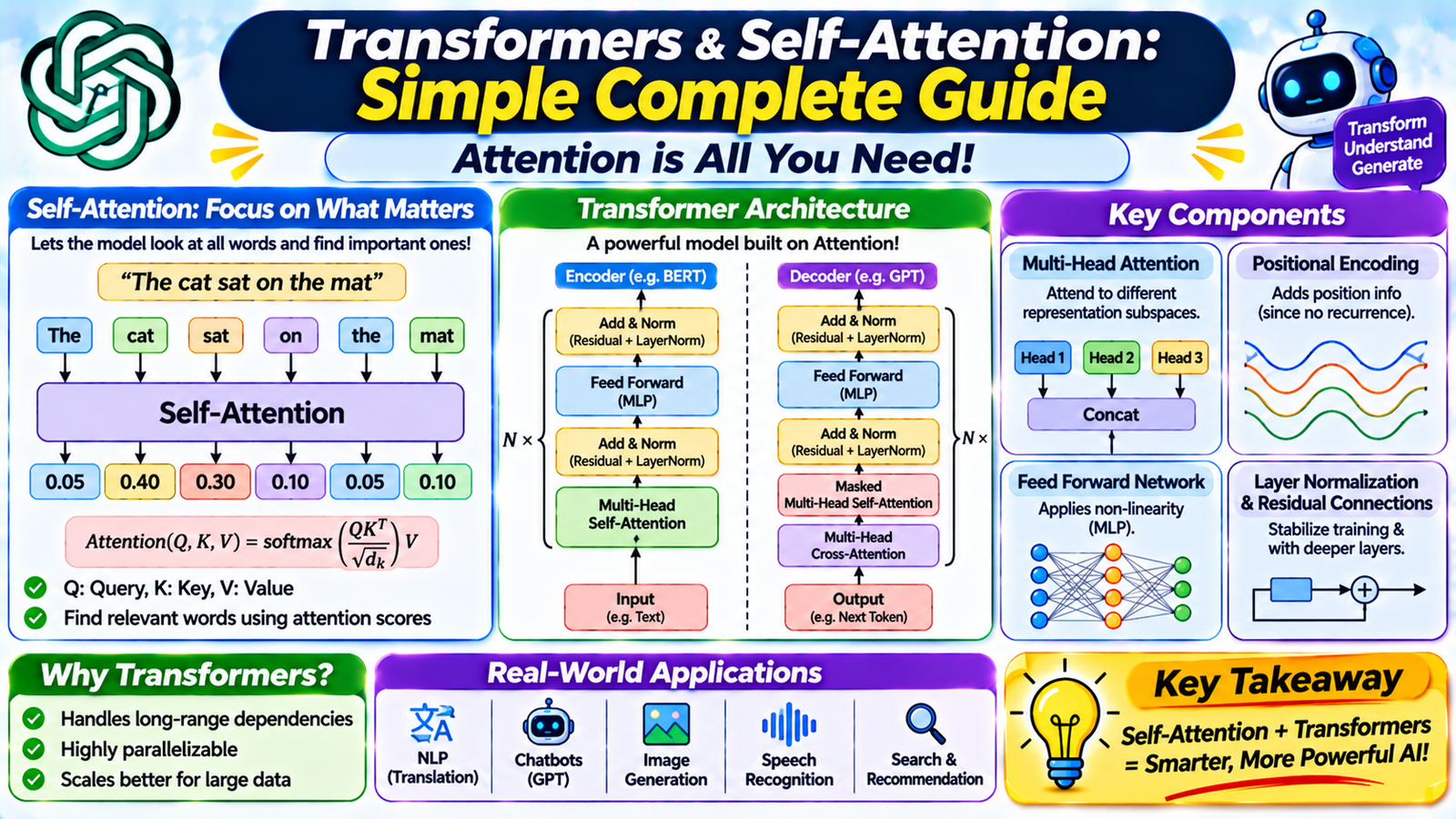
Introduced in the landmark 2017 paper "Attention Is All You Need", the Transformer architecture completely reshaped artificial intelligence. It is the engine behind modern Large Language Models (LLMs), translation tools, and image generators.
Before Transformers, models like RNNs read text one word at a time from left to right—making them slow to train and prone to forgetting earlier context. Transformers read the entire sentence all at once, using a breakthrough mechanism called Self-Attention.
1. What Is a Transformer?
A Transformer is a neural network architecture built to process sequences (like text, code, or audio) in parallel rather than sequentially.
Instead of passing information step-by-step down a chain, a Transformer looks at every word in a sentence simultaneously and figures out which words relate most strongly to each other—no matter how far apart they are.
2. How Self-Attention Works (In Plain Language)
Self-Attention is the mechanism that lets a model weigh the importance of every other word in a sentence when understanding a specific word.
Consider these two sentences:
- "The animal didn't cross the street because it was too tired."
- "The animal didn't cross the street because it was too wide."
To humans, "it" clearly refers to the animal in sentence 1, and the street in sentence 2. Self-Attention teaches a machine to make that exact connection automatically.
The Query, Key, and Value (Q, K, V) Intuition
To compute attention, the model creates three vectors for every word (token) in the input:
- Query ($Q$): "What am I looking for?" (e.g., the word "it" searching for a noun it describes).
- Key ($K$): "What do I contain / represent?" (e.g., "animal" advertising itself as a living noun; "street" advertising itself as a physical place).
- Value ($V$): "What actual meaning/information do I pass along if matched?"
The 3-Step Attention Process
- Score (Compare $Q$ and $K$): Multiply each word's Query against every other word's Key to get a relevance score.
- Normalize (Softmax): Convert those scores into percentages (attention weights) that add up to $100\%$.
- Blend (Multiply by $V$): Multiply each word's Value by its attention percentage and sum them up.
The resulting vector for "it" now carries blended context directly from "animal" and "tired".
$$\text{Attention}(Q, K, V) = \text{softmax}\left(\frac{QK^T}{\sqrt{d_k}}\right)V$$
3. Key Building Blocks of a Transformer
[Input Words] ---> [Embeddings + Positional Encoding] ---> [Multi-Head Self-Attention] ---> [Feed-Forward Network] ---> [Output]