Training deep neural networks involves balancing two competing failure modes: training instability (where gradients vanish or explode before the model learns anything useful) and overfitting (where an over-parameterized network memorizes training noise).
Three practical engineering techniques address these exact problems across nearly every modern deep learning pipeline: Weight Initialization, Dropout, and Early Stopping.
1. Weight Initialization: Setting the Starting Point
Before the first forward pass begins, a neural network's weights must be populated with initial numerical values. Setting the wrong initial scale breaks gradient flow immediately.
Why Naive Initializations Fail
- All Zeros (Symmetry Problem): If every weight is initialized to $0$, every neuron in a hidden layer computes the exact same output and receives the exact same gradient update. The neurons remain permanently identical, preventing the network from learning diverse features.
- Too Small: Signals shrink exponentially as they multiply through layers, causing vanishing gradients.
- Too Large: Signals amplify exponentially, causing exploding gradients and
NaNloss crashes.
Modern Initialization Standards
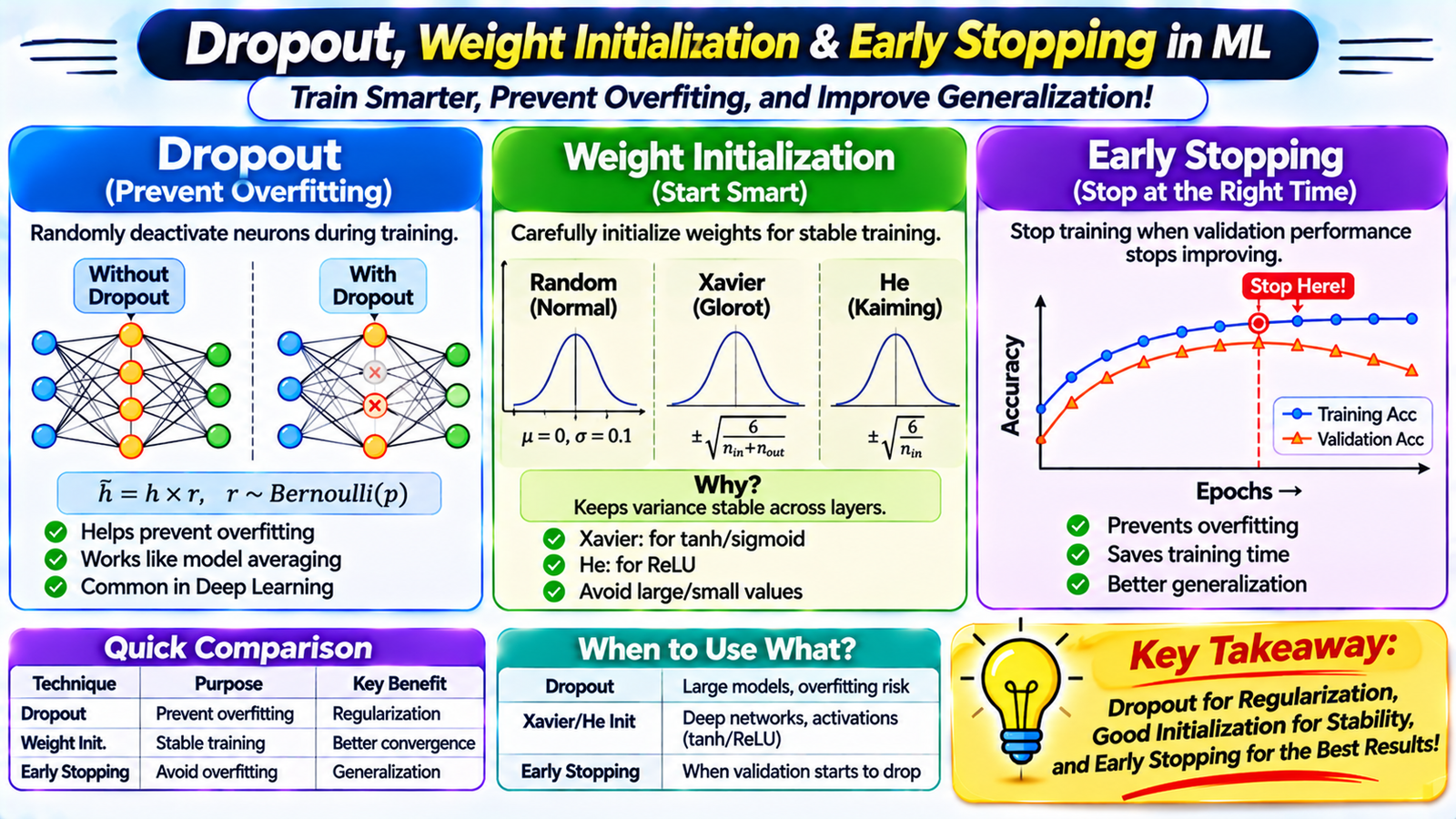
To keep activation variance stable across dozens of layers, initial weights are drawn from zero-mean Gaussian or uniform distributions scaled by layer fan-in ($n_{\text{in}}$, number of incoming connections):
| Initialization Method | Variance Formula | Designed For | Why It Works |
|---|---|---|---|
| Xavier (Glorot) | $\text{Var}(W) = \frac{1}{n_{\text{in}}}$ (or $\frac{2}{n_{\text{in}} + n_{\text{out}}}$) | Tanh, Sigmoid, Softmax | Preserves symmetric signal variance across linear/symmetric activations. |
| He (Kaiming) | $\text{Var}(W) = \frac{2}{n_{\text{in}}}$ | ReLU, Leaky ReLU, GELU | ReLU zeroes out ~50% of negative inputs, halving variance; the factor of $2$ compensates for this loss. |
2. Dropout: Preventing Neuron Co-Adaptation
Deep neural networks have millions of parameters, making them prone to memorizing training samples. Dropout is a regularization technique that forces the network to learn redundant, robust representations.
How Dropout Works
During each training step, every neuron in a dropout-enabled layer is temporarily deactivated (its output multiplied by $0$) with probability $p$ (typically $p = 0.2$ to $0.5$).
Standard Dense Network                  With Dropout (p = 0.5)
    (O)     (O)     (O)                     (O)     [X]     (O)
     | \   / | \   / |                       | \           / |
     |  \ /  |  \ /  |                       |  \         /  |
    (O) (O) (O) (O) (O)                     [X] (O) (O) [X] (O)
(All neurons active every step)       (Random sub-network sampled per batch)