Training a state-of-the-art neural network from scratch requires millions of labeled examples, massive GPU clusters, and weeks of compute time. For most real-world engineering teams, that approach is neither practical nor cost-effective.
Instead, modern AI relies on Transfer Learning and Fine-Tuning—two closely related techniques that let you take a massive model already trained on general data and adapt it to solve your specific task using a fraction of the data and compute.
1. What Is Transfer Learning?
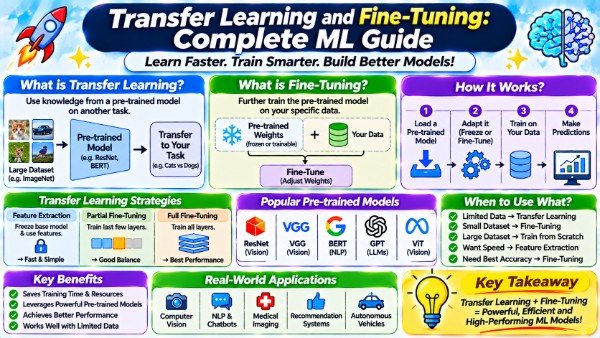
Transfer learning is the broad machine learning paradigm of reusing knowledge gained while solving one problem (the source task) and applying it to a different, related problem (the target task).
- Computer Vision Example: A Convolutional Neural Network (e.g., ResNet) trained on 1.4 million ImageNet photos has already learned how to detect edges, textures, shapes, and object parts in its early and middle layers. You can reuse those visual representations to classify X-ray scans using just 1,000 medical images.
- Natural Language Example: A Transformer pretrained on billions of words of internet text already understands grammar, syntax, and world facts. You can transfer that language knowledge to classify customer support tickets with a few hundred examples.
[ Pretrained Foundation Model ]  (Trained on massive general dataset)
               │
               ├──> Early/Middle Layers: General features (edges, grammar, syntax)
               │
               ▼
[ Target Task Adaptation ]       (Trained on small domain-specific dataset)
               │
               └──> Task-Specific Head: Custom classes, domain jargon, new output