Machine learning generally solves problems by training algorithms to detect patterns in data rather than hardcoding static rules. However, how an algorithm learns depends fundamentally on the type of data it receives and the feedback mechanism in place.
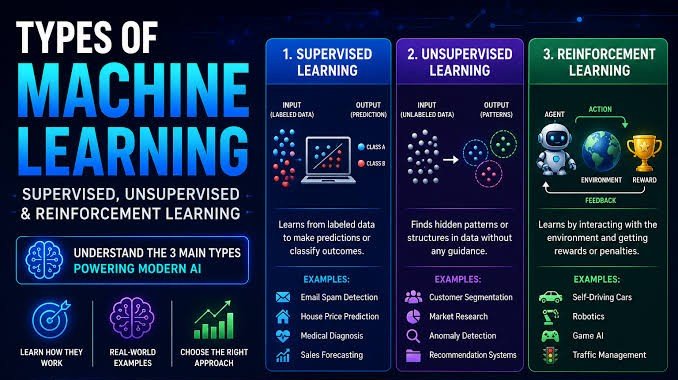
Every machine learning problem falls primarily into one of three core paradigms: Supervised Learning, Unsupervised Learning, or Reinforcement Learning. Understanding the differences between these approaches is essential for choosing the right architecture and data pipeline for any technical project.
1. Supervised Learning: Learning with a Teacher
Supervised learning is the most widely adopted machine learning approach in commercial applications today. In this paradigm, the algorithm learns from a labeled dataset, meaning every training input is already paired with the correct output or ground-truth answer.
The objective is to learn a mapping function $f(x) = y$ that maps input variables ($x$) to target variables ($y$) accurately enough to predict the label for unseen data.
How Supervised Learning Works
- You provide the model with training pairs consisting of features and known labels (e.g., house features and selling price).
- The model makes a prediction and compares it with the actual ground-truth label.
- An optimization algorithm (such as gradient descent) adjusts internal parameters to minimize error via a defined loss function.
Key Sub-Types
- Classification: Predicts discrete class labels or categories.
- Examples: Spam detection (spam vs. not spam), medical scan diagnosis (benign vs. malignant), image classification.
- Common Algorithms: Logistic Regression, Support Vector Machines (SVM), Random Forests, XGBoost, Convolutional Neural Networks (CNNs).
- Regression: Predicts continuous numerical values.
- Examples: Stock price forecasting, real estate valuation, demand forecasting.
- Common Algorithms: Linear Regression, Ridge/Lasso, Gradient Boosted Decision Trees, Neural Networks.
Major Challenges
- Data Labeling Bottlenecks: Requires large, accurate, human-annotated datasets, which can be costly and labor-intensive to produce.
- Overfitting Risk: Models can easily memorize training noise rather than true underlying patterns if regularization is insufficient.
2. Unsupervised Learning: Discovering Hidden Structure
In unsupervised learning, the algorithm receives data without explicit labels or target answers. The system is left to discover underlying structures, relationships, groupings, or distributions on its own.
How Unsupervised Learning Works
Rather than predicting an external target variable, unsupervised algorithms compute mathematical proximity, density, or statistical variance across high-dimensional feature spaces.
Key Sub-Types
- Clustering: Groups data points so that items in the same cluster are more similar to each other than to items in other clusters.
- Examples: Customer segmentation for marketing, gene sequencing analysis, document grouping.
- Common Algorithms: K-Means, DBSCAN, Hierarchical Clustering.
- Dimensionality Reduction: Compresses feature spaces while retaining as much informative variance as possible.
- Examples: Data visualization, noise filtering, feature preprocessing for deep models.
- Common Algorithms: Principal Component Analysis (PCA), t-SNE, UMAP.
- Anomaly Detection: Identifies outliers that deviate significantly from standard distribution baselines.
- Examples: Credit card fraud detection, industrial equipment defect monitoring.
- Common Algorithms: Isolation Forests, One-Class SVMs, Autoencoders.
Major Challenges
- Evaluation Difficulty: Because there is no objective "ground truth" target, validating model quality requires qualitative domain expertise or heuristic metrics like silhouette scores.
- Interpretability: Discovered clusters may reflect statistical noise rather than actionable business logic.
3. Reinforcement Learning: Learning Through Interaction and Reward
Reinforcement Learning (RL) takes inspiration from behavioral psychology. Instead of learning from a static dataset, an autonomous agent interacts directly with an environment through trial and error.
The goal of the agent is to determine an optimal strategy or policy ($\pi$) that maximizes cumulative scalar rewards over time.
How Reinforcement Learning Works
The classic RL loop consists of four key components:
- State ($S_t$): The current status of the environment observed by the agent.
- Action ($A_t$): A decision executed by the agent based on its policy.
- Reward ($R_{t+1}$): Scalar feedback from the environment indicating the success or failure of the action.
- Next State ($S_{t+1}$): The updated environment state resulting from the executed action.
Key Applications
- Robotics and Control: Autonomous navigation, robotic limb articulation, factory drone routing.
- Gaming and Simulations: AlphaGo, Chess engines, dynamic NPC logic.
- LLM Alignment: Reinforcement Learning from Human Feedback (RLHF) used to align conversational AI and foundation models.
- Algorithmic Trading: Optimizing trade execution timing and portfolio rebalancing under dynamic market conditions.
Major Challenges
- Sample Inefficiency: Training often requires millions of simulated iterations before achieving acceptable performance.
- Reward Shaping Complexity: Poorly formulated reward functions can cause reward hacking, where the model discovers unintended exploits rather than solving the target problem.
- Exploration vs. Exploitation Tradeoff: Balancing the discovery of new strategies against exploiting known high-reward actions.
Quick Comparison: At a Glance
| Feature | Supervised Learning | Unsupervised Learning | Reinforcement Learning |
|---|---|---|---|
| Input Data | Labeled ($X, y$) | Unlabeled ($X$) | Interactive Environment |
| Objective | Predict labels / values | Discover hidden patterns | Maximize cumulative reward |
| Feedback Type | Direct ground truth | None (heuristic distances) | Delayed rewards / penalties |
| Primary Tasks | Classification, Regression | Clustering, Dimension Reduction | Policy optimization, Navigation |
| Human Effort | High (labeling data) | Low (data collection only) | High (environment & reward design) |
How to Choose the Right Approach
When starting an ML initiative, use this workflow to select the paradigm:
- Do you have well-defined target answers or outcomes for historical records? - Yes: Use Supervised Learning.
- Do you want to explore user patterns, compress dimensions, or find unexpected outliers without labels? - Yes: Use Unsupervised Learning.
- Is your task a multi-step sequence of decisions where an agent acts in a simulated or real-time environment with quantifiable feedback? - Yes: Use Reinforcement Learning.
Understanding where your problem fits ensures you build the right data collection strategy from day one.