A machine learning model can easily score 99% accuracy in training while failing catastrophically in production. The root cause is almost always how data was divided, tested, or preprocessed during development.
To build models that reliably generalize to the real world, you must master three foundational data hygiene concepts: Train/Validation/Test Splits, Cross-Validation, and Data Leakage.
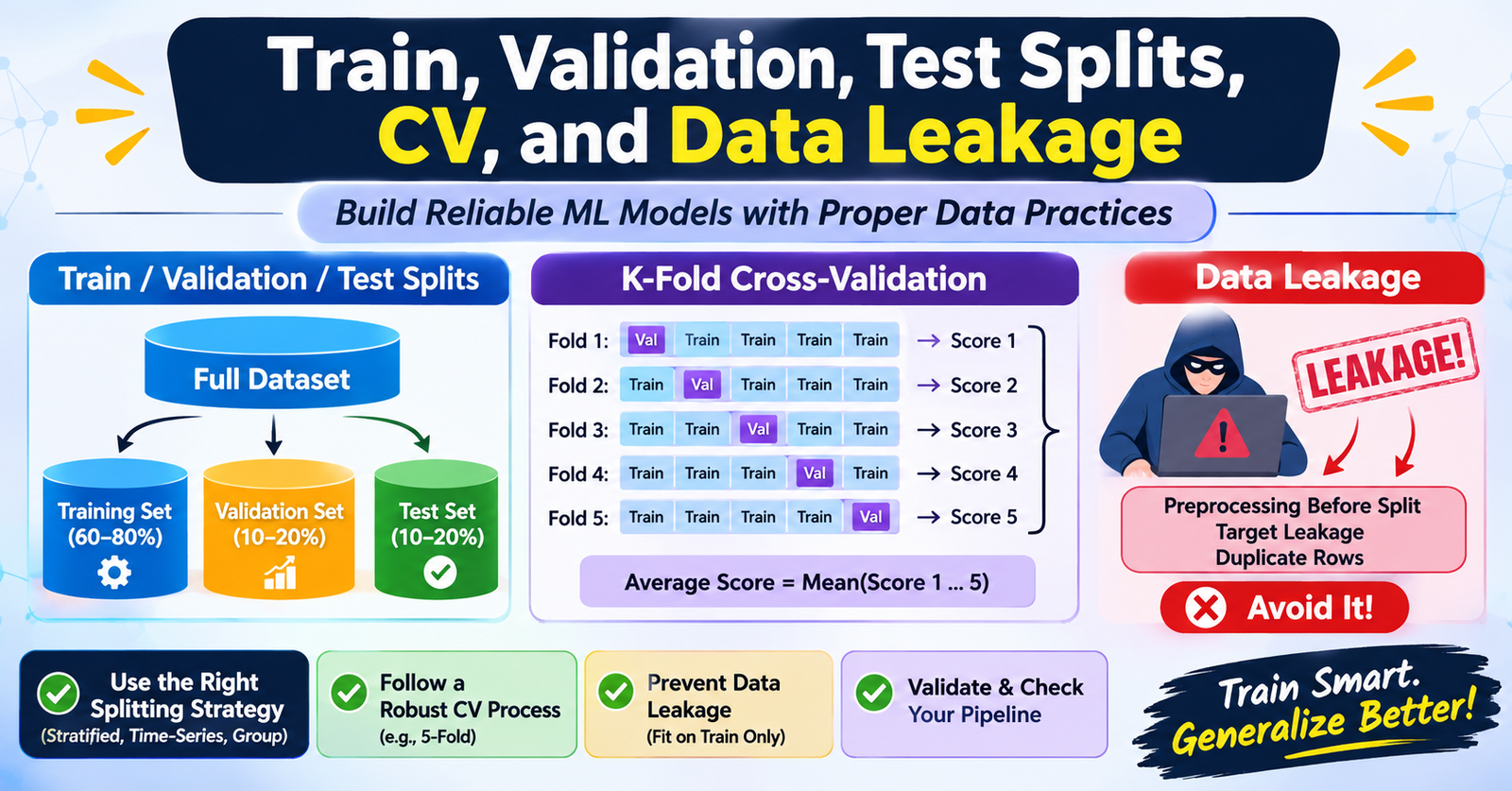
1. Train, Validation, and Test Splits
Partitioning your data into isolated subsets prevents the model from memorizing answers and gives you an honest assessment of performance.
+-------------------------------------------------------+
|                    Full Dataset                       |
+-----------------------------------+---------+---------+
|           Training Set            | Val Set | Test Set|
|              (60–80%)             | (10–20%)| (10–20%)|
+-----------------------------------+---------+---------+
The Three Subsets Defined
- Training Set (60–80%): The primary data fed directly into the model to update weights, compute gradients, or construct tree branches.
- Validation Set (10–20%): The tuning benchmark. Used repeatedly to evaluate performance during training, adjust hyperparameters (such as learning rates or tree depth), and decide when to stop training (early stopping).
- Test Set (10–20%): The final evaluation vault. Kept strictly locked away until all modeling and hyperparameter decisions are final. It acts as an unbiased stand-in for future production data.
Golden Rule: Never train on your validation set, and never tune hyperparameters on your test set. Once you touch the test set to make decisions, its evaluation becomes compromised.
2. Advanced Splitting Strategies
A basic random shuffle works well only for uniform, balanced datasets. Real-world data often demands specialized approaches:
Stratified Splits
- The Problem: When target classes are imbalanced (e.g., 99% non-fraud vs. 1% fraud), a purely random split might put zero fraud cases into your validation or test sets.
- The Solution: Stratified sampling ensures each split preserves the exact proportional class distribution of the overall dataset.
Time-Series / Chronological Splits
- The Problem: Standard random shuffling lets the model look into the future to predict past events, creating artificially inflated metrics.
- The Solution: Use temporal splits. Train on months 1–8, validate on months 9–10, and test on months 11–12. Never train on future observations to predict earlier events.
Group-Based Splits
- The Problem: If multiple rows come from the same entity (e.g., medical scans from the same patient or speech samples from the same speaker), random splitting scatters a single individual's data across both train and test. The model ends up memorizing patient characteristics rather than disease patterns.
- The Solution: Use GroupKFold or group-aware splits to ensure all rows belonging to a single entity remain exclusively within one split.
3. Cross-Validation: Maximizing Data Utility
When working with small or moderately sized datasets, reserving a static 20% validation split removes too much valuable training signal. K-Fold Cross-Validation resolves this issue.
Fold 1: [ Val ] [Train] [Train] [Train] [Train]  -> Score 1
Fold 2: [Train] [ Val ] [Train] [Train] [Train]  -> Score 2
Fold 3: [Train] [Train] [ Val ] [Train] [Train]  -> Score 3
Fold 4: [Train] [Train] [Train] [ Val ] [Train]  -> Score 4
Fold 5: [Train] [Train] [Train] [Train] [ Val ]  -> Score 5
Average Score = Mean(Score 1 .. 5)
How K-Fold Works
- Set aside your untouched Test Set first.
- Divide the remaining training pool into $k$ equal segments (folds), typically $k=5$ or $k=10$.
- Train the model on $k-1$ folds and validate on the remaining fold.
- Repeat this loop $k$ times so every fold serves as the validation set once.
- Average the validation scores to compute a robust estimate of generalization error.
4. Data Leakage: The Silent Model Killer
Data leakage occurs when information from outside the training dataset contaminates the model during development. It creates deceptively high evaluation scores that collapse once deployed.
Common Leakage Vectors
1. Preprocessing Before Splitting (Train-Test Contamination)
- The Mistake: Applying normalization (e.g.,
StandardScaler), mean imputation, or target encoding across the entire dataset before splitting into train and test sets. - Why It Fails: Calculating the global mean or standard deviation incorporates test-set distribution properties into the training pipeline.
- The Fix: Fit all transformers, scalers, and encoders strictly on the training split, then use those fitted parameters to
transformthe validation and test splits (e.g., using scikit-learnPipeline).
2. Target Leakage (Temporal & Feature Infiltration)
- The Mistake: Including a feature that is only created after or at the exact moment the target outcome occurs.
- Example: Using "Account Closure Timestamp" or "Customer Support Cancellation Survey Result" to predict whether a customer will churn.
- The Fix: Ensure every feature in your training row was strictly known and available at the exact prediction timestamp.
3. Duplicate and Overlapping Rows
- The Mistake: Applying oversampling techniques (such as naive upsampling or SMOTE) to the entire dataset prior to splitting.
- Why It Fails: Exact duplicates or synthetic variations of test rows end up inside the training set.
- The Fix: Split first, then oversample only inside the training fold.
The Production-Ready Validation Checklist
| Phase | Best Practice |
|---|---|
| Splitting | Isolate and lock the final Test Set before any exploratory data analysis (EDA) or modeling. |
| Distribution | Use StratifiedKFold for imbalanced labels; use temporal ordering for time-series data. |
| Pipeline Encapsulation | Wrap imputation, scaling, feature selection, and model training into a single reproducible Pipeline. |
| Feature Audit | Inspect top-importance features. If an engineered feature delivers near 100% accuracy, inspect it for target leakage. |
| Metric Sanity Check | Expect validation performance to drop slightly compared to training; if validation loss is zero or suspiciously high, check for leakage. |